Contents on this Page
French Immersion Program
In Manitoba, the first French immersion classes began in 1973. Since 1995, Manitoba Education and Early Childhood Learning (MEECL) has recognized French immersion as one of the four official K–12 school programs. Since 1974, the Bureau de l’éducation française (BEF), a division of MEECL has been mandated to develop, evaluate and administer policies and programs related to French education. A brief historical overview of the Program ( 263 KB) presents the milestones in French immersion in Canada and Manitoba.
What is French Immersion?
The French Immersion Program is, first and foremost, a language program that is based on the philosophy of learning language through content in authentic and meaningful academic, cultural, and social situations. Students learn to communicate in French while learning most subjects in French. French is used as the language of instruction and as a means of communication in the classroom and throughout the school. The unique character of the Program derives from the fact that the French language is both the medium and the object of instruction.
There are two models for organizing a French Immersion Program: the single-track model where the entire school population is enrolled in the French Immersion program and the dual-track model where the French Immersion Program and English Program co-exist in the same school.
Who is the French Immersion Program for?
French immersion is an inclusive program intended for ALL students with various abilities and needs whose first language is not French and who have little or no knowledge of the French language.
The French Immersion Policy in Manitoba
The French Immersion Policy in Manitoba provides a common framework for the full implementation of the Program as well as a series of administrative policies and requirements of the French Immersion Program for Manitoba schools.
The French version of the French Immersion Policy in Manitoba is also available.
Framework for Learning
The Framework for Learning, intended for teachers, brings together the essential elements of learning and teaching in Manitoba, including curricula and assessment.

The Vision of the French Immersion Program
The Vision of the French Immersion Program in Manitoba ( 1.65 MB) lays the foundation for the French Immersion Program so that students benefit from a rich French Immersion experience where they develop their French language proficiency, achieve academic success, and cultivate their plurilingual identity. The goal of the French Immersion Program is to develop proud, confident, engaged, plurilingual global citizens. The French version of the vision document is also available. ( 1.78 MB)
Student Pathway in French Immersion
The vision of French immersion in Manitoba ( 1.65 MB) is realised in the student’s pathway ( 2.00 MB) who:
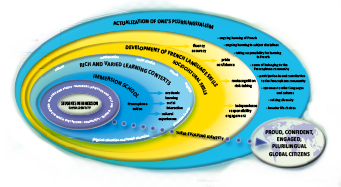
- arrives at the French immersion school already having their own identity which is constantly evolving through the interactions they experience with their environment and the people around them;
- interacts in the francophone environment created by the school in varied social, cultural, and academic contexts;
- develops socio-cultural and language competencies;
- actualizes their plurilingualism by participating in the Francophone space and community, developing a sense of belonging and openness to other languages and cultures.
Students’ ongoing pathway, each year and throughout their French immersion journey, allows them to become proud, confident, engaged, plurilingual global citizens.
The Importance of Language, Culture and Identity in French Immersion
In French immersion, language, culture and identity are interconnected and interdependent. The interaction between language and culture creates a space where the student's identity is constantly evolving through their social, cultural and academic interactions in French in each of the school disciplines and within the school.
Language in the French Immersion Program
French language acquisition is at the heart of the French Immersion Program and must be at the forefront of the minds of school leaders, educators, students, and parents. Since opportunities to speak French outside of school are often limited, it is essential to multiply authentic communication situations throughout the school setting.
Culture in the French Immersion Program
For French immersion students, school is not just a place where they spend time and learn but also a cultural and linguistic milieu. It is an environment where they feel valued in their culture of origin, as well as in their emerging linguistic and cultural identity. This environment becomes a place where students can build a repertoire of socio-cultural referents, acquire the cultural values conveyed by the French language, and enjoy rich experiences that will enable them to develop their plurilingual identity.
In order for students to discover and share in Francophone culture, they must have multiple opportunities to interact with Francophone communities so that they become familiar with Francophone cultural referents: local, national, and international.
Identity in the French Immersion Program
All students enter school in the French Immersion Program with their own unique identity. This multidimensional identity develops through family, friends, community, the groups they belong to, languages spoken at home, culture, beliefs, values, and experience. Supported by their parents who validate their French immersion experience, students see their identity evolve through their experiences and interactions in French.
Répertoire d'activités éducatives et culturelles

Le Répertoire d’activités culturelles et éducatives (RAEC) (in French only) is intended for Manitoba educators from Kindergarten to Grade 12 who work in French‑language education. The proposed activities support the integration of language, culture, and identity within educational activities.
Going to French Immersion School in Manitoba
Where are the French Immersion schools located?
The French Immersion Program is offered from Kindergarten to Grade 12 in public schools in 23 out of the 37 school divisions throughout Manitoba.
- List of French Immersion Schools in Manitoba ( 110 KB)
- French Immersion schools in Winnipeg ( 4.70 MB)
- French Immersion schools outside of Winnipeg ( 4.34 MB)
- French Immersion schools in Winnipeg (
- Interactive map of French Immersion schools in Manitoba
When can a student enter the French Immersion Program?
Any child turning five years old by December 31 may attend Kindergarten.
In Manitoba, there are three official entry points into the French Immersion Program. No matter when students enter the Program, the intent is that students continue through to Grade 12. The three official entry points are as follows:
- Early Immersion – Kindergarten or Grade 1
- Middle Immersion – Grade 4
- Late Immersion – Grade 6 or 7
The most common official entry point is early immersion.
Some schools also offer middle and late immersion.
Note: Schools may also offer flexible entry points that allow a student to enter outside of the official entry points. Flexible entry is based on school division policies and the schools' ability to provide appropriate academic and linguistic supports the student may need. Parents can contact their local school division or French immersion school to inquire about its policies and practices.
How to register?
To find out where to register your child, and what programs are offered, contact your local school division office or school.
Proportion of Time Taught in French
Language of instruction
- In Kindergarten, French is the language of instruction for 100% of the time except when the child’s well-being requires the use of English.
- From Grade 1 to Grade 6, French is the language of instruction for 75% to 80% of the time.
- For Grades 7 and 8, French is the language of instruction for the majority of the time, from 50% to 86%.
- For Grades 9 to 12, a minimum of 15/30 credits or 50% of instructional time is required to be taught in French in order to obtain a French immersion diploma*.
- Cultural and extra-curricular activities in French are offered to support language skill development outside the classroom.
| Subject Areas | Grades 1 to 6 |
Grades 7 and 8 |
|
|---|---|---|---|
| Compulsory | English language arts - Immersion | 20% | 14% |
| Français | 15% | 13% | |
| Mathématiques | 15% | 17% | |
| Sciences de la nature | 10% | 13% | |
| Sciences humaines | 10% | 13% | |
| Éducation physique et Éducation à la santé | 11% | 9% | |
| Éducation artistique | 10% | 8% | |
| Optional |
ex. : career development | 9% | 13% |
| Total | 100% | 100% | |
| Grade Level | Required Minimum Number of Credits from Courses Taught in French | Compulsory French Courses |
Other Courses Taught in French |
|---|---|---|---|
| Grade 9 | 4 credits | Français arts langagiers – immersion | Students must earn 10 or more credits from courses taught in French from the options available to them. Details found in the following documents: |
| Grade 10 | 4 credits | Français arts langagiers – immersion | |
| Grade 11 | 3 or 4 credits* | Français arts langagiers – immersion | |
| Grade 1 | 3 or 4 credits* | Français arts langagiers – immersion | |
|
Minimum of 14 credits* | 4 credits | Minimum of 10 credits* |
In accordance with The French Immersion Policy in Manitoba (2023), as of September 2024, students starting Grade 9 must earn a minimum of 15 credits from courses taught in French of the 30 required to obtain a provincial French immersion diploma. The additional required credit from a course taught in French must be earned in either Grade 11 or 12.
For more information, visit:
- Graduation Requirements for Manitoba High School Diplomas
- Graduation Requirements for the Senior Years French Immersion – Technology Education Program ( 72 KB)
Resources for Parents
- My Child in School: A Resource for Parents, French Immersion Program. (in English only) A website that provides a brief overview of the curricula and required courses for each grade level.
- FAQ for parents (coming soon)
- CPF Home - Canadian Parents for French
Contact
French Language Education Policy and Planning Unit
Bureau de l’éducation française
Manitoba Education and Early Childhood Learning
Phone: 204-945-6916
Email: bef.pol-plan@gov.mb.ca