The study of English language arts enables Kindergarten to Grade 12 learners to explore, understand, and appreciate language and its use in multi-dimensional ways—through critical thinking, communicating, creating, collaborating, and reflecting—to empower learners to live Mino-pimatisiwin (The Good Life) and to contribute to their communities as global, literate citizens.
All Kindergarten to Grade 12 teachers contribute to their students’ literacy development, supporting learner growth and transformation over time. This includes supporting learners’ growth as readers and writers across disciplines and contexts. Each learner develops literacy knowledge and skills through opportunities to listen, speak, read, write, view, and represent in a variety of cultural, linguistic, and community contexts. The language arts are interrelated and interdependent; growth in one area strengthens and supports development in others.
English language arts empowers Kindergarten to Grade 12 learners to engage with multiple modes of communication—known as multiliteracies—across diverse contexts. In today’s rapidly evolving landscape of texts, English language arts equips learners with the skills to navigate and interpret multimodal texts that blend print, digital, oral, and visual elements, including Indigenous oral traditions, stories, and knowledge shared across generations.
Through these text experiences, Kindergarten to Grade 12 learners question, investigate, create, communicate, and reflect in order to make sense of the world around them, drawing on varied perspectives, relationships, and lived experiences.
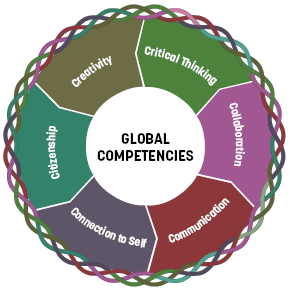
Across Kindergarten to Grade 12, English language arts curricular learning outcomes provide the foundation for developing global competencies. Through engagement with a range of texts, ideas, and experiences, learners apply and deepen these competencies to communicate, collaborate, think critically, and act purposefully, while developing a sense of self and identity, strengthening connections to communities, and expanding their understanding of the world as active and responsible participants.
English language arts serves as the gateway to self-knowing, being, and doing, engaging learners’ imaginations, inspiring lifelong learning, and promoting appreciation for the diversity of human experiences conveyed through language, literature, and story.
In Manitoba, the Kindergarten to Grade 12 English language arts curriculum rests on the following four interconnected strands:
This strand develops the foundational role of language that supports overall literacy development. Listening and speaking lay the groundwork for reading and writing as learners investigate how language works, including its sounds, patterns, and structures, and discover the power of words to construct and express meaning. Reading and writing develop together as learners engage with traditional and contemporary texts to construct meaning across contexts. As learners progress, oral language continues to anchor comprehension, reasoning, and collaboration; at the same time, expanding vocabulary and word knowledge enable the creation and interpretation of increasingly complex texts. Across the grades, learners deepen their engagement with language by exploring and experimenting with its features, refining communication skills, and using language and literacy as powerful tools for learning and selfexpression.
This strand develops the learner’s capacity to comprehend, interpret, and engage with and respond to a wide range of texts. Learners draw on prior knowledge and experiences as they acquire new information, construct meaning, and think critically about ideas and perspectives. They question, analyze, and evaluate texts by considering purpose, audience, and context. Responding involves expressing understanding, making connections, and communicating insights through discussion, writing, and other forms of representation. Across the grades, learners develop and refine ways of comprehending, interpreting, and thinking critically about texts through engagement with a range of texts and experiences. They deepen their learning, broaden perspectives, and shape how they engage with ideas and viewpoints from social, cultural, and historical contexts.
This strand develops the learner’s capacity to express and communicate ideas through purposeful and creative text creation. Learners generate ideas, plan, and draft texts in print, digital, and multimodal forms, engaging in a full composing process that also includes revising, editing, and publishing. Through revision, they refine language, structure, and style to communicate meaning with clarity, precision, and creativity for different purposes and audiences. Across the grades, learners demonstrate increasing growth as text creators, crafting texts to share stories, express identity, and contribute meaningfully to their communities.
This strand develops the learner’s capacity to share ideas effectively and to deepen learning through reflection. Learners engage in collaborative dialogue and presentations to clarify thinking, build new understandings, and express ideas clearly and purposefully across a range of audiences and contexts. Reflection supports learner agency, as they assess progress, set goals, and use feedback to improve. Across the grades, communication serves as a tool for inquiry, problem solving, and collective learning, supporting the ongoing transformation of understanding through shared thinking, reflection, and relational approaches to knowledge building.
Critical thinking in English language arts involves the intentional process of synthesizing and analyzing ideas using criteria and evidence, making reasoned judgments, and reflecting on the consequences and implications of those judgments.
When the English language arts curriculum is used to foster critical thinking as a competency, learners
Creativity in English language arts involves exploring and playing with ideas and concepts to represent thinking, solve problems, explore opportunities, and innovate in unique ways. It is the interaction between intuition and thinking.
When the English language arts curriculum is used to foster creativity as a competency, learners

Citizenship in English language arts involves engaging with others and working toward a more equitable, compassionate, and sustainable world through the development and value of relationships to self, others, and the natural world.
When the English language arts curriculum is used to foster citizenship as a competency, learners
Connection to self in English language arts involves awareness of the related nature of emotional, intellectual, physical, social, cultural, and spiritual aspects of living and learning, and the responsibility for personal growth and well-being.
When the English language arts curriculum is used to foster connection to self as a competency, learners

Collaboration in English language arts involves learning with and from others and working together with a shared commitment to a common goal.
When the English language arts curriculum is used to foster collaboration as a competency, learners
Communication in English language arts involves interacting with others and allowing for a message to be received, expressed, and understood in multiple ways and for a variety of purposes.
When the English language arts curriculum is used to foster communication as a competency, learners
Language and literacies are central to all learning.
Today’s learners need a broad communicative repertoire to interact with and navigate multiple forms of text and social contexts.
Language and literacies are context-dependent.
Today’s learners will understand how to use language and literacies for different contexts, such as navigating different purposes, audiences, and cultural contexts.
Language and literacy learning is complex, continuous, and recursive.
Today’s learners will realize that language and literacy learning are dynamic and provide opportunities for learners to return to and reflect on their learning, which expands their experiences, interactions, and relationships.
Language and literacies develop differently for each individual.
Today’s learners have unique and diverse ways of developing and expanding their language and literacies.
Language and literacy learning and use are social.
Today’s learners will experience language and literacies through the processes of communication, conversation, and collaboration to make meaning when interacting with text and creators of texts.
Language and literacy demands are evolving.
Today’s learners require the capacity and capability to navigate multiple uses of language, multiliteracies, and multimodal texts (print, digital, physical, aural/oral, gestural, spatial, and visual modes).
Language and literacy experiences inform and influence our developing sense of self.
Today’s learners are affected by their language and literacies, and this defines how they construct their personal identity. English language arts is essential for all to live Mino-pimatisiwin (The Good Life). The English language arts curriculum acknowledges literacy as a fundamental right and that it is at the heart of the learner’s knowing, being, and doing.
Language and literacies are enacted through inextricably connected practices.
Today’s learners will use a range of modes to make and communicate their meaning through language and literacy.